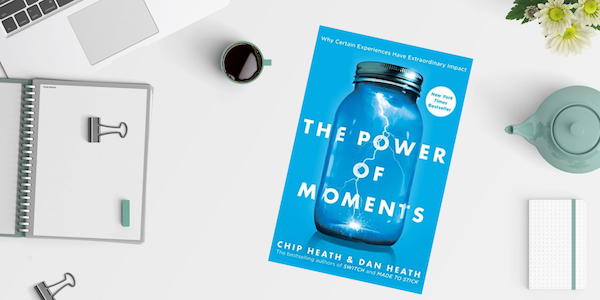
I recently finished applying to graduate school, which was…shall we say, a rather emotionally draining experience. In retrospect it would’ve been nice to have read Chip and Dan Heath’s The Power of Moments before starting my applications – perhaps “thinking in moments”, as they put it, would have helped me with burnout and kept my motivation high.
It’s not as if doing so would have taken a lot of time away from me either, as The Power of Moments is, for lack of a better word, a cute read. While fairly substantial at nearly 300 pages long, the author duo’s friendly, vaguely jaunty prose combined with the way the book is organized helps the reader never get bored or exhausted while reading. Rather than one long shpiel, The Power of Moments is comprised of an assortment of short stories, each one relevant to the larger section it lies within. The book boasts five main segments – a brief introduction explaining how we can think of our lives in moments, then four large pieces describing different types of moments: moments of elevation, of insight, of pride, and of connection.
Now, what do all of these things mean? And why do I/we care? Frankly, the pop psychology of this book is not anything particularly shocking. While some statistics and stories sprinkled throughout are rather interesting, none of the stories nor the point they contribute to making should be anything revolutionary to anyone. However, there is value in putting “feelings” into “words”, and it is useful to be able to consciously make important moments happen in our lives rather than have it occur passively. At the very least, you’ll walk away thinking ‘huh, that’s neat’, or perhaps with some sense of motivation to make your life a better one. Can’t lose, really.
Anywho, The Power of Moments is based around one central idea: to rethink our lives in terms of defining moments. The Heath brothers open up with the most easily comprehended type of moment: ones of ‘elevation’. Put simply, these are specific instances of something happening in our lives that we will recall in the future, whether because it was our first time doing something significant, or because it was unusual. Good examples might include a work promotion or marriage, which are big transitions/milestones in our lives. On a smaller scale, first-time experiences such as going to a bar at 21 or our first significant other are included in this conversation. The authors thus recommend for us to actively build peaks into our own lives in order to feel higher highs rather than a growing sense of ennui as we age.
Moments of insight are similar, but revolve more around a change in mindset. It can be either ‘good’ or ‘bad’ – the authors use a variety of examples in which the subject ‘trips over the truth’, thus leading to some sort of realization about their life. In simpler words, moments of insights are instances where someone has an epiphany, causing them to re-evaluate the way they might have thought about something before. The section goes on to describe how good mentors can push us to have more of these in a manner that urges us to seek improvement in our lives.
The third section of the book covers moments of pride, which are rather self explanatory. Two things about this section stand out in particular. First, the authors suggest that courage is the key to moments of pride – to stretch ourselves in ways not done before and/or to achieve something we might not have imagined was possible are usually the best ways to create such instances. Additionally, we can multiply meaningful milestones – reframing a long journey so that it features many “finish lines”. Reaching these finish lines, regardless of how small, can make a daunting task that much more digestible in the long run.
Finally comes moments of connection, my personal favorite section of The Power of Moments. In my head, this is the one most valuable for everyone to understand and be able to utilize. To try and succinctly summarize: moments of connection are times when we bond with others – usually this is through shared struggle or experience. Of course, this usually is synonymous with the length of a relationship as well. The authors acknowledge this, but with the caveat that relationships can often deepen quickly should something particularly poignant occur. The flipside is true as well – relationships can plateau if left unattended, lacking in excitement or freshness.
Going back to my opener about graduate school applications, it would have been a big help to me if I’d read this book before starting. Of course, as I described, none of the material in this book is shocking, per se. However, much of pop psychology is like this – things that we know, and experience, yet somehow can’t put a word to or make happen consciously. I can see three out of four types of moments inherent in my application journey already, for instance.
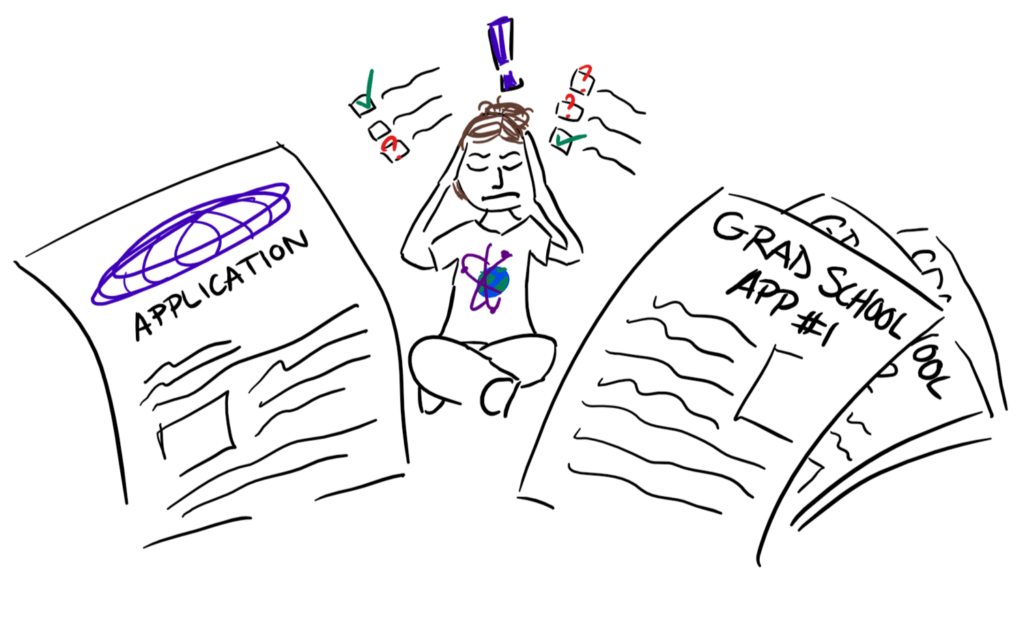
Four schools, five programs, all due within roughly a month of each other. Graduate school applications have been a long process harkening back to June or so of 2019, which is when I began seriously studying for the GRE. Since then, I’ve plugged away at applications amidst two jobs and a full credit-hour autumn quarter, making sure my resume and transcripts were correct and up-to-date, taking the GRE exam for real in September, and of course, creating and shredding countless revisions of multiple essays for every school.
It felt like I was on a noble mission where the stakes were my future, so as the days rolled by I submitted one after another without fail. By the end of it I was operating like a machine, filling in test scores by memory and employment history as if I knew it better than the back of my hand.
December 15th, January 7th, January 15th, January 20th. UW. Columbia. Cornell. Then UW again. Finally, January 23rd rolled around and I submitted my final application to Carnegie Mellon University, paying the $75 application fee with my credit card, which had been loaded up with charges from every school.
At long last, I was finished. But to my dismay, there was no sense of accomplishment or wash of relief. In fact, I didn’t feel much of anything. I simply felt empty. The frenzy of applications had come to an end without much pomp and circumstance, flowing into an 8-week waiting period before hearing back from any school. I was drained.
So where did I go wrong? First thing that comes to mind: I had thrown myself into the application process with only one goal in mind: to finish. I suppose finishing applications would have been a moment of elevation, though I had defeated myself by envisioning only the future acceptances (or, god forbid, rejections) instead.
By neglecting the small milestones to feel victorious about along the way, I had also set myself up for a pyrrhic victory when it came to finishing each application. In hindsight, it is mildly irritating when I consider that each application’s submission would have made for quite the convenient milestone. Hindsight is truly 20-20. But what type of ‘moment’ does this constitute? It seems to entirely fit the bill for “Moments of Pride”, at the very least. I could’ve certainly taken a little bit more pride in finishing each application as I went, and perhaps rewarded myself in some form emotionally if nothing else.
Even here, now, reflecting on my graduate school application journey in this new mindset can be considered a moment – one of insight, where I’ve made up my mind to reconsider the way I approach work in the future. To be able to wield my mindset consciously is a powerful weapon – I certainly intend to bolster my friendships with more elevated and connected moments in the future, for instance. What might you take away from it all? Take a read and find out – I may have been skeptical at first, but it’s actually quite worth some thought.
 Chansin